
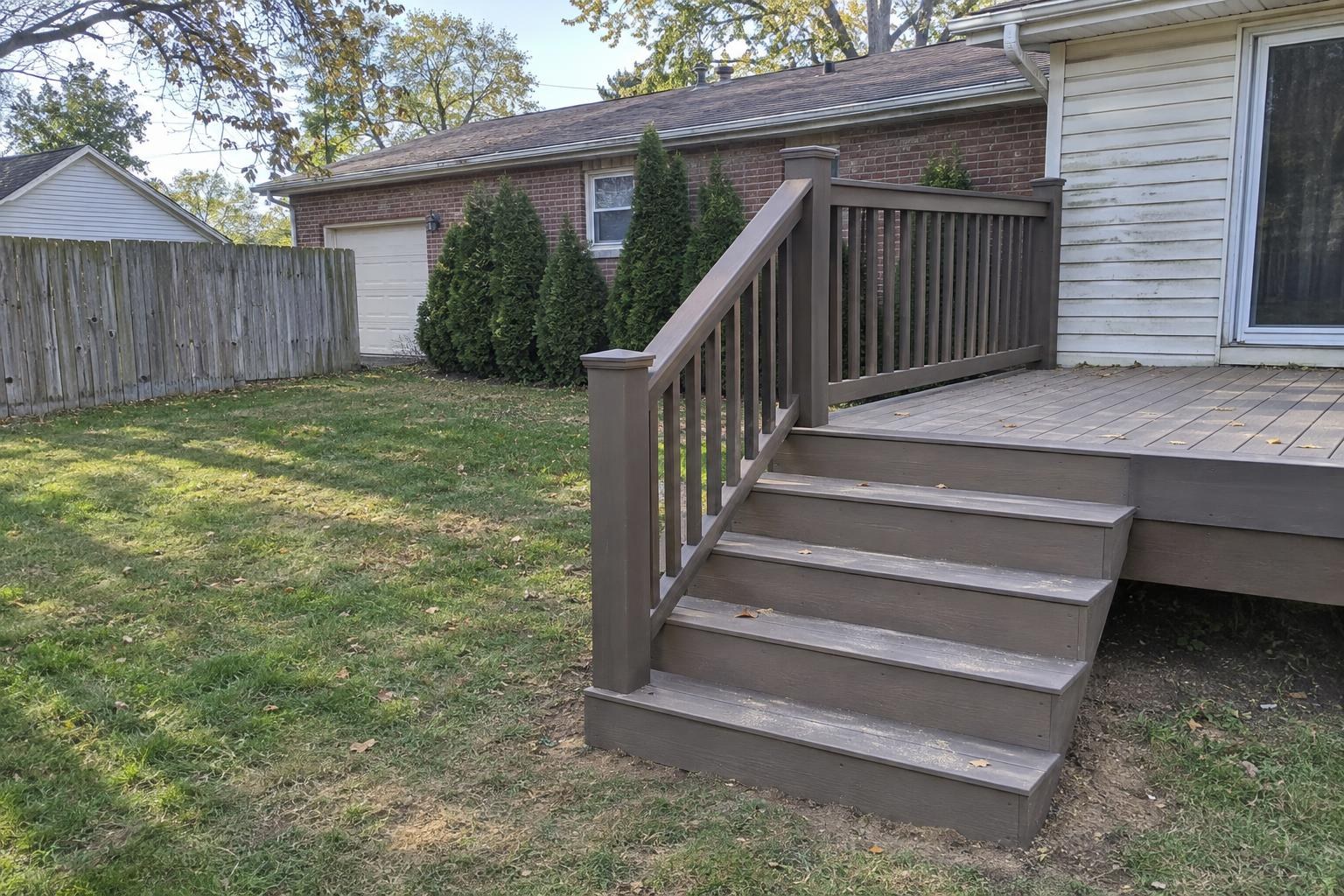
Most people shopping for a deck builder end up comparing three bids that all say roughly the same thing. Licensed, insured, free estimate. That tells you nothing about whether the footings will hold up through a Streamwood winter or whether the ledger board is going to let water behind it in five years. Here's what actually separates one builder from another, and what should make you walk.
Start with what's under the house, not above it
Northeastern Illinois sits on heavy clay till left behind by the glaciers. Clay holds water when it's wet and pulls away from itself when it dries out, and that movement is what cracks a shallow footing or heaves a post base that wasn't set deep enough. Cook County building code requires deck footings to go below the frost line, which in this area is generally 42 inches. A builder who tells you 12 or 18 inches is fine, or who pours a footing on a day in October without checking how deep they actually dug, is setting you up for a deck that rocks by the third winter. Ask how deep the footings will go and ask them to show you, not just tell you.
Freeze-thaw is the other half of it. Streamwood gets repeated cycles across the freezing point from November through March, sometimes several in a single week in late winter. Concrete that isn't properly cured, or a post base that traps water instead of shedding it, takes that cycling hardest. It's one more reason the footing depth and the drainage around it matter more here than in a warmer climate.
How the ledger attaches is where most failures start
If the deck is attached to the house, the ledger board connection is the single most important joint in the whole structure. It needs to be lag-bolted or through-bolted into the band joist or rim joist of the house, not just nailed to the siding, and it needs flashing above it so water running off the house sheds past the joint instead of soaking into it. This is the detail that's invisible once the decking boards go down, and it's also the one inspectors in Streamwood check for specifically before they'll sign off on framing. A builder who wants to skip the inspection, or who says permits for decks aren't really necessary, is skipping the one step that catches this kind of mistake before it's buried under your new boards.
Permits, inspections, and why the process exists
In Streamwood, a deck attached to the house or built above a certain height from grade needs a permit through the village's building department. Expect at least two inspections: one for the footings before concrete gets poured, and one for the framing before decking and railing go on. If your lot is close to a side or rear setback line, which happens often on the older, tighter lots near the center of town, the village may also want to see a plat of survey to confirm you're not building into the setback. A contractor who's done work here knows this process cold and can tell you roughly how long it takes without guessing. One who avoids the subject, or suggests doing the work without pulling a permit to save time, is asking you to take on the liability yourself if something goes wrong or if you ever try to sell the house with unpermitted work attached to it.
Some subdivisions around Streamwood also have HOAs with their own rules on railing style, decking color, or setback from the fence line. It's worth checking before you fall in love with a composite color the board won't approve.
What the age of your house tells you about the job
Streamwood grew up mostly through the 1960s through the 1980s, so a lot of the original decks out there are 20 to 40 years old and were built to a lower standard than current code requires, smaller footings, no hurricane ties, joists spaced wider than they should be for the lumber size. A repair or a tear-off on one of these older decks is a different job than new construction on a newer lot near the edges of town. A good builder will tell you if your existing structure isn't salvageable instead of patching boards onto a frame that's already failing underneath. If a contractor only looks at the decking boards and never gets under the deck to check the joists and the ledger, they haven't actually inspected it.
Materials, and being honest about tradeoffs
Pressure-treated pine is still the cheaper, more common framing material here, and it holds up fine as structure if it's properly flashed and drained. For the decking surface itself, composite boards have gotten a lot more common because they don't need yearly staining and they don't splinter, but they do expand and contract with summer heat more than wood does, so the gapping between boards matters more with composite, not less. A builder who installs composite with the same tight gaps they'd use on wood is setting up buckling the first hot July. Wood decking, by contrast, needs to be stained or sealed every 2 to 3 years in this climate to keep the freeze-thaw cycling and the summer humidity from checking and graying the boards. Ask which material they'd actually put on their own house, not just which one they make the most margin on.
Red flags worth walking away from
- No mention of a permit, or a suggestion that you don't need one for an attached deck.
- A quote with no footing depth, joist spacing, or fastener spec written down anywhere.
- Pressure to pay the full amount upfront before any material is delivered.
- No answer when you ask how they're attaching the ledger to the house.
- A refusal to get under an existing deck before quoting a repair.
None of these take long to ask about. A builder who's actually done the work will have straight answers to all of them, usually before you finish asking.
If you're weighing a new deck, a repair, or just trying to figure out whether your existing one is still sound, Fairmont Deck Solutions works on all of it around Streamwood and the surrounding towns, and we're glad to walk through what your specific lot and your specific deck actually need before you spend anything.